
Book Review: Atlas of the Heart by Brené Brown
Most of you probably know by now that I am a big fan of Brené Brown. I have read most of her books and I usually find myself highlighting something, thinking about something, or talking about something long after I have finished the book. Atlas of the Heart was released on November 30, 2021. I have friends that read it when it came out and loved it, I bought the book soon after it’s release and I honestly don’t know why I have waited so long to read it.
The premise of this book is that there are 87 different emotions and experiences that we all have, but we don’t always have the words to explain what we are feeling. Brown describes the book as a kind of map that helps us understand where we are, what we are feeling, and how we can better connect with other people. I watched an interview with Brown where she explained that as she started her research for this book there were 3 emotions that people seemed to always use; happy, sad and angry. She then goes on to explain that having the language to describe our emotions helps us to better understand ourselves and others and can improve our interactions with others.
One of the things I really liked about this book is Brown’s explanation of the difference between emotions that we often lump together. For example, there is a difference between stress and overwhelm, between disappointment and regret, and between jealousy and envy. We tend to use these words interchangeably, but they aren’t actually the same thing. She calls these “near enemies” and illustrates the importance of having the right word for what we are feeling to help us understand what is really going on.
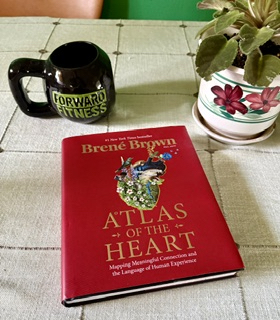
The book is broken up into 13 Chapters around emotions that go together. They are all labeled as “Places we go … For example one of my favorite Chapters is Chapter 7: Places we go with others. This chapter looks at compassion, pity, empathy, sympathy, boundaries and comparative suffering. She makes the point that empathy is not about trying to fix someone’s problem or telling them that things could be worse. Sometimes we just need to sit with someone in whatever they are feeling. She counters that sympathy is actually a disconnection tool that people use. Sympathy is feeling sorry for a person from a distance.
The thing that makes Atlas of the Heart different is the way Brown organizes all of these ideas around emotions. It really made me think about how often we expect other people to understand what we are feeling when we haven’t even taken the time to figure it out ourselves. The final chapter of the book “Cultivating Meaningful Connection” brings the book together. In this chapter we get to the heart of how having the language of emotions can help our interactions with ourself and others.
One of my favorite ideas from the book is that language can actually change our experiences. If I can identify what I am feeling, I have a much better chance of figuring out what I need to do about it. Instead of just knowing that I am having a bad day, maybe I can figure out that I am disappointed, frustrated, lonely, or worried. Those feelings require very different responses
Atlas of the Heart is nota book that you need to sit down and read straight through as quickly as possible. In fact, I think it might be better to read a little, think about it, and then come back to it. You can look at the chapters and think about the emotions that resonate with you and read one or two and then come back to other chapters when they are meaningful to you. I would also recommend reading the final chapter early on in your exploration of the book. The book also includes some wonderful graphics and a weird aside but it is a physically heavy book. I thought about taking it on a trip but decided it would add too much weight to my luggage. Many of you know I love an audio book, but I really think to truly engage with this book the way that Brown wants you to, you need to have the physical book. I don’t think you would have the same experience on an e-reader or as an audio book.
So, yes, I would recommend another Brené Brown book. I know, shocking. If you have read her other books, you will find some familiar ideas here, but I think the focus on understanding and naming emotions makes this one worth reading.